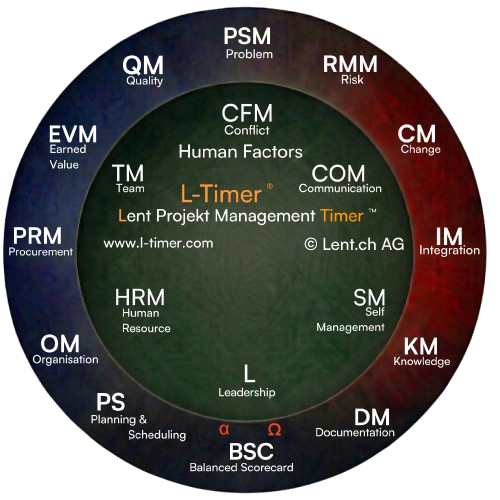
L-Timer Mental Model
Cybernetics, mental models, theoretical foundation
Process Overview
Scroll table →
| Hour | Code | Process Name | Objectives |
|---|---|---|---|
| 07:00 | P&S | Planning and Scheduling | Development, structuring, and planning of the project objective and the pathway to its achievement; quantitative specification of results in alignment with customer requirements and the overarching strategies of the resource-providing organisation. Within a continuous cybernetic feedback loop, the project leader iteratively reviews and adjusts both the objectives and the plans for achieving them. |
| 08:00 | OM | Organization Management | Definition of roles, responsibilities, functions, and the organisational structure of all project stakeholders required to achieve the project objective; establishment of clear interfaces, decision rights, and reporting relationships that enable coordinated and effective project execution. |
| 09:00 | PRM | Procurement Management | Ensuring that all formal interactions with manufacturers and suppliers throughout the project are consistently oriented toward the optimal achievement of the project objective, while maintaining strict compliance with applicable legal regulations and with the requirements of the organisation financing the project. |
| 10:00 | EVM | Earned Value Management | Continuous monitoring of all project processes with regard to compliance with plans for achieving the project objective by verifying results attained, deadlines met, and financial expenditures incurred, while explicitly considering unplanned events and deviations within the project. |
| 11:00 | QM | Quality Management | Continuous assurance that project results, processes, and all parameters defined in project requirements remain aligned with the project objectives and implementation plan. Quality management should promptly detect deviations from the plan and propose effective corrective measures. |
| 12:00 | PSM | Problem Solving Management | Identification and resolution of technical and organisational problems by the project team using appropriate analytical, creative, and collaborative methods. |
| 13:00 | RMM | Risk Mitigation Management | Minimising overall project risk through the continuous, creative, and timely identification of potential threats, their systematic analysis, and the development and implementation of appropriate countermeasures. |
| 14:00 | CM | Change Management | Systematic recording, evaluation, and decision-making regarding proposed changes to the project, including the option to implement, modify, or suspend them. Changes to the project should be minimised where possible, and updated system configurations must be continuously monitored. |
| 15:00 | IM | Integration Management | Ensuring effective integration of project results into the surrounding system environment — including technology, organisation, processes, and human aspects — while achieving a high level of satisfaction among all relevant project stakeholders. |
| 16:00 | KM | Knowledge Management | Ensuring effective creation, sharing, and utilisation of knowledge within the project through available formal, organisational, and supportive mechanisms and tools. |
| 17:00 | DM | Documentation Management | Creation, structuring, and archiving of all documentation related to project outcomes in a form that enables easy retrieval and practical use by users, system configurators, and service departments. |
| 18:00 | BSC | Balanced Scorecard | Multilateral assessment of the project using recognised, integrated, and comprehensive performance metrics that evaluate the project’s positive and lasting contribution to the strategic objectives of the organisation financing the project. |
| 20:00 | HRM | Human Resource Management | Careful selection of individuals for formal roles in the project based on their skills and experience, while also considering their personalities and informal roles within the team. Ensuring the personal and professional development of employees in alignment with the project objectives and the strategy of the organisation funding the project. |
| 22:00 | TM | Team Management | Maximising group performance with a primary focus on team results, assessed through project stakeholder satisfaction and the quality of project outcomes. |
| 00:00 | CFM | Conflict Resolution Management | Early recognition of potential conflicts within the project team and in the broader project environment; application of an effective, methodical approach to conflict resolution and prevention of the recurrence of similar conflicts in the future. |
| 02:00 | COM | Communication | Ensuring effective, goal-oriented communication among all project stakeholders, both within the project organisation and in the broader project environment. |
| 04:00 | SM | Self Management (Work & Life Balance) | Maintaining personal well-being, life satisfaction, and continuous personal development as essential foundations for effective decision-making, leadership, sustained project performance, and a positive perception of the project by its stakeholders. |
| 06:00 | L | Leadership | Skilful guidance and motivation of the project team and other active stakeholders to achieve project goals in a coordinated and committed manner. |