Project management can be understood as the direction and control of activities undertaken to achieve a more or less precisely defined goal, based on information obtained through various channels and feedback mechanisms. Norbert Wiener termed this field of thought cybernetics, referring broadly to the control and communication in “machines and living beings,” deriving the concept from the Greek word κυβερνήτης (kybernetes) meaning “helmsman” or “steersman” (Wiener, 1948, 1961).
The earliest documented use of the term cybernetics in a scientific context predates Wiener. In 1843, the Polish philosopher Bronisław Trentowski introduced cybernetyka as the art of governing a nation, deriving it from the Greek verb κυβερνάω (kybernáō – to govern). Trentowski’s thinking already contained elements of systemic reasoning: he recognised the purposiveness of continuous reform of the state based on historical experience and dynamic adaptation.
However, his strongly theistic and normative stance limited his scientific neutrality — despite his academic status as a habilitated scholar. He did not fully embrace the idea of autonomous self-regulation of systems, instead advocating a constitutionally imposed form of monarchy as the preferred governance model.
Nevertheless, several aspects of Trentowski’s work can be seen as precursors to modern cybernetic thought. In particular, his postulate of a tripartite separation of powers — legislative, executive, and judicial — introduced a form of systemic balance. He also implicitly conceived the Sejm (parliament) as a feedback mechanism capable of correcting decisions made by those in power.
His final assertion that “cybernetics must view the social condition through active thinking, aiming at actions appropriate to various necessities and requirements” — inspired by what he termed “Napoleonic practice” — comes remarkably close to Wiener’s later conception of cybernetics as a practical science of control, feedback, and purposeful action.
Since the 1950s, numerous applications of cybernetic thinking to social and organisational systems have been published. Among the most frequently cited contributors in this field are Beer (1959, 1973), Waelchli (1987), and Malik (2016), whose work systematically transferred cybernetic principles to management, organisations, and governance. Cybernetic ideas were also integrated into educational contexts, as reflected in the early pedagogical contributions of Smith and Smith (1966).
In addition, Sajay (1996) demonstrated that key elements of cybernetic reasoning can already be identified in the work of Mary Parker Follett from the 1920s, particularly in her concepts of coordination, mutual adjustment, and dynamic interaction within organisations — long before cybernetics became an established scientific discipline.
During the 1960s, related lines of thinking also developed in Central and Eastern Europe, where several authors independently connected cybernetics with control, organisation, and purposeful action. Marian Mazur (1976, 1986) conceptualised cybernetics primarily as a science of control systems, emphasising feedback, regulation, and stability in both technical and social contexts. Tadeusz Kotarbiński (1965/1982), from a praxeological perspective, analysed efficient action and organisation in ways that later resonated with cybernetic models of management. Oskar Lange (1962, 1965) explored links between cybernetics and economics, particularly the role of feedback mechanisms in decision-making and adaptive planning.
Taken together, these contributions illustrate that cybernetic thinking evolved in multiple intellectual traditions, all of which converge on a common idea: organisations — including projects — can be understood as systems that require feedback, coordination, and continuous adaptation to achieve their goals.
Wiener's cybernetic system with feedback from the environment is illustrated in Fig. 1.1:
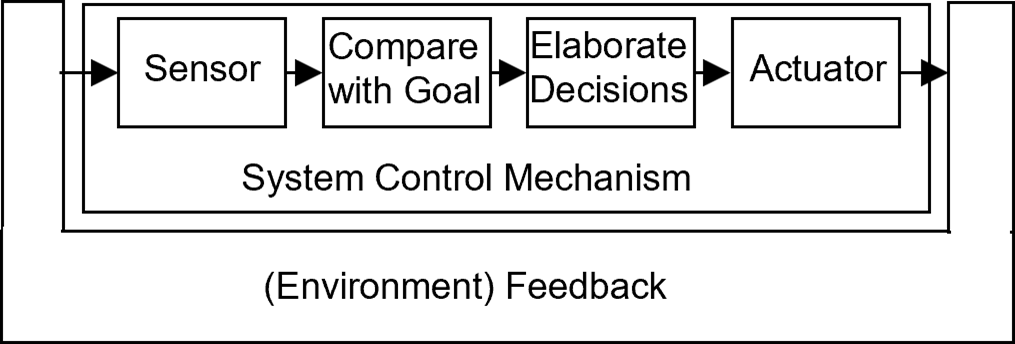
Fig. 1.1 Wiener's cybernetic system
Wiener’s universal cybernetic approach, equally applicable to animals, humans, and machines, fits perfectly with the management processes involved in project management: a person seeks to bring a project to a specific result using technical, organisational and cognitive means. In this interpretation, the environment that provides feedback corresponds to the project itself, the mechanics of the system represent project management processes, and the goal corresponds to the project objective.
Wiener attempted to summarise his cybernetic model in mathematical form. While this is feasible — albeit highly complex (Lent, 1989) — for binary or strictly logical variables, systems involving variables with multiple possible states lead to non-linear and dynamic relationships (Wiener, 1948, 1961; Kaplan, 1984, 1991).
Such complex systems neither converge to a single stable equilibrium nor disintegrate into pure chaos. Instead, they store, process, and exchange information with their environment. They are characterised by spontaneity, adaptability, and a form of internal dynamism that resembles living systems (Waldrop, 1992).
Classical systems theories often model cybernetic systems as closed systems, assuming that their equilibrium states can be predicted with reasonable accuracy based on a limited number of possible configurations. However, this assumption becomes increasingly problematic when applied to socio-technical systems such as projects, where feedback is continuous, context-dependent, and shaped by human interpretation and decision-making.
However, non-linear systems are extremely sensitive to initial conditions and are capable of exhibiting multiple possible states of equilibrium. Small variations at the outset can therefore lead to significantly different trajectories and outcomes.
Moreover, classical cybernetic analysis of complex systems often assumes a relatively stable or comparable environment. This assumption does not hold in design and project contexts: each project represents a unique case, embedded in a distinct technical, organisational, and social setting, and therefore cannot be treated as fully comparable to previous cases.
Consequently, the behaviour of dynamic systems — including projects — can only be predicted to a limited extent, which inevitably introduces uncertainty and inaccuracy. The role of chance further reinforces this limitation. As a result, forecasting in such systems is inherently probabilistic rather than deterministic, making it difficult to determine outcomes with certainty (Stewart, 2002).
From a computational perspective, project management can be characterised as an NP-complete problem, meaning that it is not feasible to calculate the final state of the system in finite time for all possible conditions. Nevertheless, short-term approximation is possible (Bousquet, 2009, Gadomski and Lent, 2017). This justifies the practical relevance of project management: even if long-term prediction remains uncertain, it is still meaningful and necessary to manage projects based on reasonable, continuously updated forecasts over shorter time horizons.
In 1974, Heinz von Foerster introduced the concept of a second-order cybernetic feedback loop, in which the observer itself becomes part of the cybernetic system. In this view, the “system control mechanism” in Fig. 1.1. no longer stands outside the system but constitutes its own cybernetic system with an internal feedback loop (von Foerster, 2002).
Consequently, a first-order cybernetic system is not observed from a single, neutral control point; rather, it is perceived through multiple second-order cybernetic systems, each equipped with its own sensory and interpretative filter. This situation is schematically illustrated in Fig. 1.2.
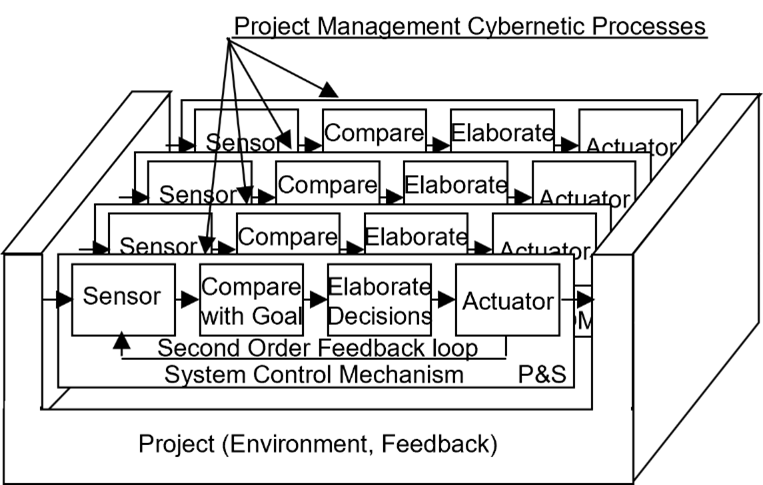
Fig. 1.2 Cybernetic model of project management
From the perspective of each second-order cybernetic system, all external variables — including the environment and the primary system — are interpreted and effectively linearised through its individual filter. This implies that a purely external “freezing” or stabilisation of the environment does not eliminate internal variability within second-order systems, because their responses depend on their own structures, goals, and feedback mechanisms rather than solely on external conditions.
In the example shown in Fig. 1.2., the project and its environment provide feedback not only to the primary control system but also to various second-order cybernetic systems, such as Planning & Scheduling or Leadership. Each of these systems constructs its own operational reality of the project based on its specific perspective, priorities, and internal regulation mechanisms.
The process groups defined in ISO 21500:2012, which have already been introduced earlier in this chapter, can be interpreted as elements of second-order cybernetics. In this perspective, the groups of initiation, planning, implementation, and completion represent project management processes, whereas the control processes correspond to the control mechanism of the cybernetic system that regulate and stabilise project behaviour (see Fig. 1.3.).
However, ISO 21500:2012 does not explicitly provide a feedback loop from or within the control process group. In other words, the standard treats e.g. initiation primarily as a one-time starting point rather than as a phase that can be revisited in light of feedback from project control.
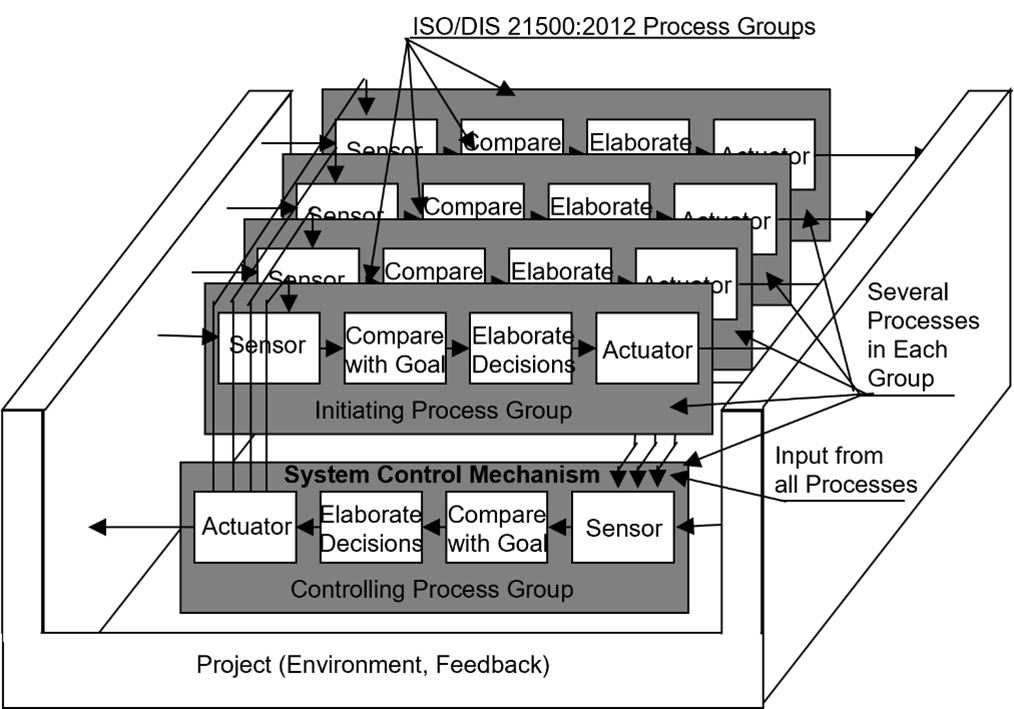
Fig. 1.3 Cybernetic model of project management in accordance with ISO 21500:2012
This structural limitation is also retained in ISO 21502:2020, which replaced the concept of “processes” with that of “practices” but did not fundamentally alter the underlying logic of the life-cycle representation (see Fig. 1.4.). Figure 1.4. does not reproduce the structure of ISO 21502:2020; it represents a cybernetic interpretation of the standard from the perspective adopted in this book.
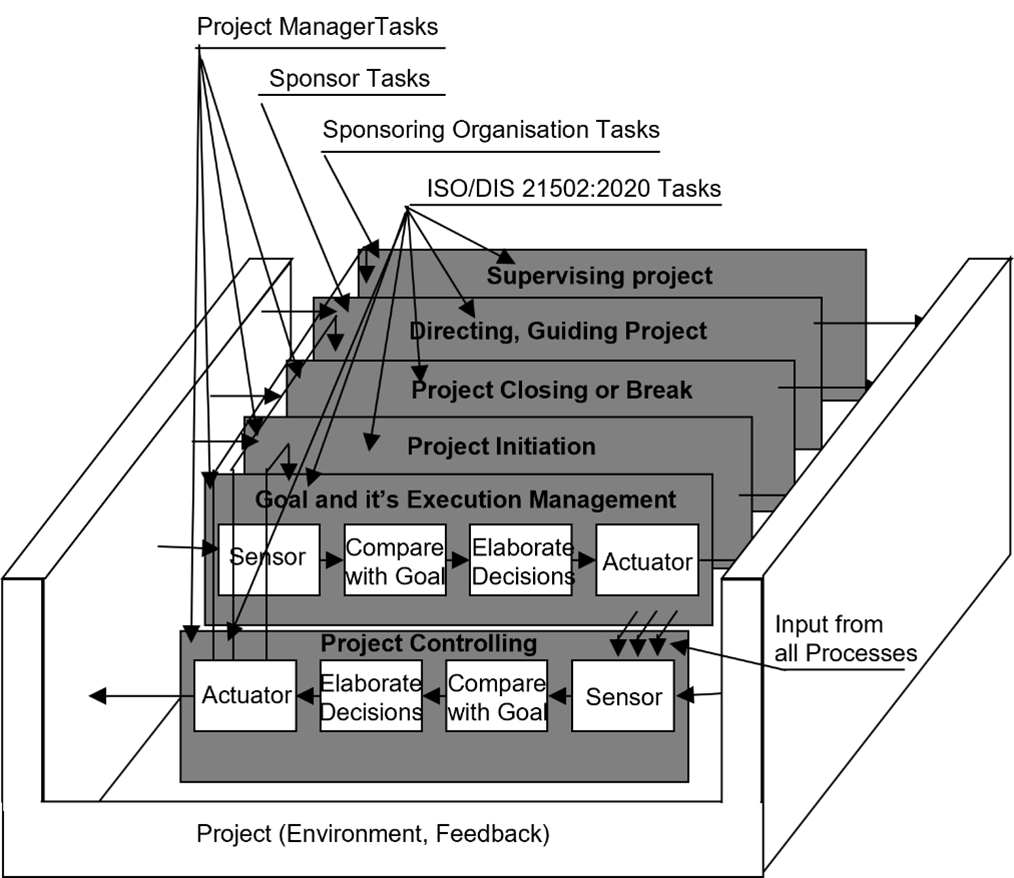
Fig. 1.4 Cybernetic interpretation of ISO 21502:2020 project management practices. The lower loop represents continuous feedback-based control acting upon all project processes
From a cybernetic perspective, this means that the ISO framework models project management more as a partially closed control cycle rather than as a fully recursive learning system in which feedback can systematically reshape the very definition and framing of the project itself.
Since initiation may extend over many months and often requires substantial organisational and financial resources, it is both reasonable and necessary to subject initiation processes (or practices) to systematic control. The outputs of pre-project activities carried out by the organisation sponsoring or supervising the project constitute the inputs to the initiation process group. Consequently, the initiation group — like all other project management process groups — must process information from both the project itself and its environment in a controlled and feedback-driven manner.
By contrast, it is generally less critical to exercise the same level of control over the practices associated with project completion or termination, as these activities typically involve relatively minor costs compared to the overall project expenditure.
Figures 1.3. and 1.4. illustrate that neither ISO 21500:2012 nor ISO 21502:2020 explicitly provide for a feedback-based control mechanism acting upon the initiation group itself. From a cybernetic perspective, this representation does not fully correspond to the empirical reality of project management, where initiation is frequently revised, adjusted, or even partially restarted in response to new information.
In practice, control processes — such as progress control (later addressed in this book as 10:00 Earned Value Management (EVM)), quality management, and overall project assessment — operate within closed feedback loops, in the same way as all other project management processes. These loops continuously compare planned and actual states, generate corrective actions, and thereby regulate project behaviour over time.
This suggests that a more consistent cybernetic representation of project management would treat initiation not as a one-time starting event, but as a controllable and revisitable process embedded in the same feedback structure as all other project phases.
Although the names of individual ISO process groups or practices may suggest that they occur only at specific moments in the project life cycle, a closer reading of their descriptions indicates that they are directly or indirectly repeated in every project phase. In practice, planning, execution, monitoring, and decision-making continuously interact rather than forming strictly separated sequential steps.
For this reason, the cybernetic model — with its principles of feedback, closed control loops, and cyclical progression — provides a more adequate conceptual representation of project management. By allowing for continuous iteration and adjustment, it supports incremental optimisation of actions and decisions over time, thereby reflecting the inherently dynamic character of projects. At the same time, the cybernetic perspective contributes to a functional “linearisation” of tasks by structuring them around recurring patterns of sensing, comparing, deciding, and acting.
Consequently, cybernetics not only clarifies the logic of project management processes and their interrelationships but also makes them more comprehensible and practically manageable. By framing project management as a feedback-regulated system rather than a one-directional sequence of activities, it reduces conceptual complexity and facilitates more consistent implementation.
For von Foerster, the project manager himself becomes an observer within the cybernetic system. In this interpretation, the project manager operates as a third-order feedback loop embedded within a second-order loop, which represents project management as a whole (von Foerster, 2002).
The project manager’s own cybernetic feedback loop — in which personal experience, reflection, and external information from the project and its environment function as continuous feedback — is illustrated in Fig. 1.5. This loop shapes how the manager perceives the project situation, interprets signals, and constructs meaning from them.
Consequently, this individual feedback system forms the cognitive foundation for all managerial decisions in directing and controlling project management processes.
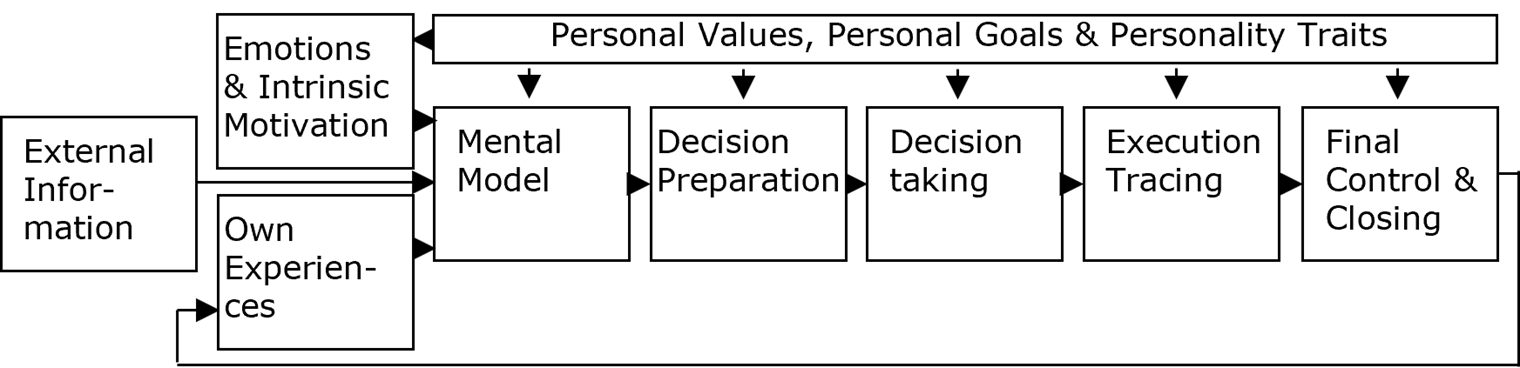
Fig. 1.5 Decision-making process
A more detailed analysis of the decision-making process — understood here as a third-order cybernetic system — is presented in Chapter 04:00 Self-Management (Work & Life Balance) (SM).
In contrast, the concepts of first-order cybernetics (the project and its environment) and second-order cybernetics (project management processes) are treated together in the subsequent chapters, as their interaction forms the core of the cybernetic perspective on project management developed in this book.