G2

L-Timer · Human Factor "Six Senses" · G2

Team Management

TM 22:00

Overview

What Is It?

Team Management (TM) welds together team members chosen in HRM towards best possible efficiency of the whole team.

Who Does It?

It is primarily task of project manager to exercise the leadership (L) and steer the team towards optimal efficiency.

Why Is It Important?

Working in a team, one likes is the second, past the project goal, most motivating factor; and motivation lead to tenfold performance. On the other side, people underperform, when they take time to find their social position in team – and this is unavoidable. Their productivity is influenced by interpersonal relationships and multicultural impact. So, it is the question of productivity to care about in Team Management.

What Are the Steps?

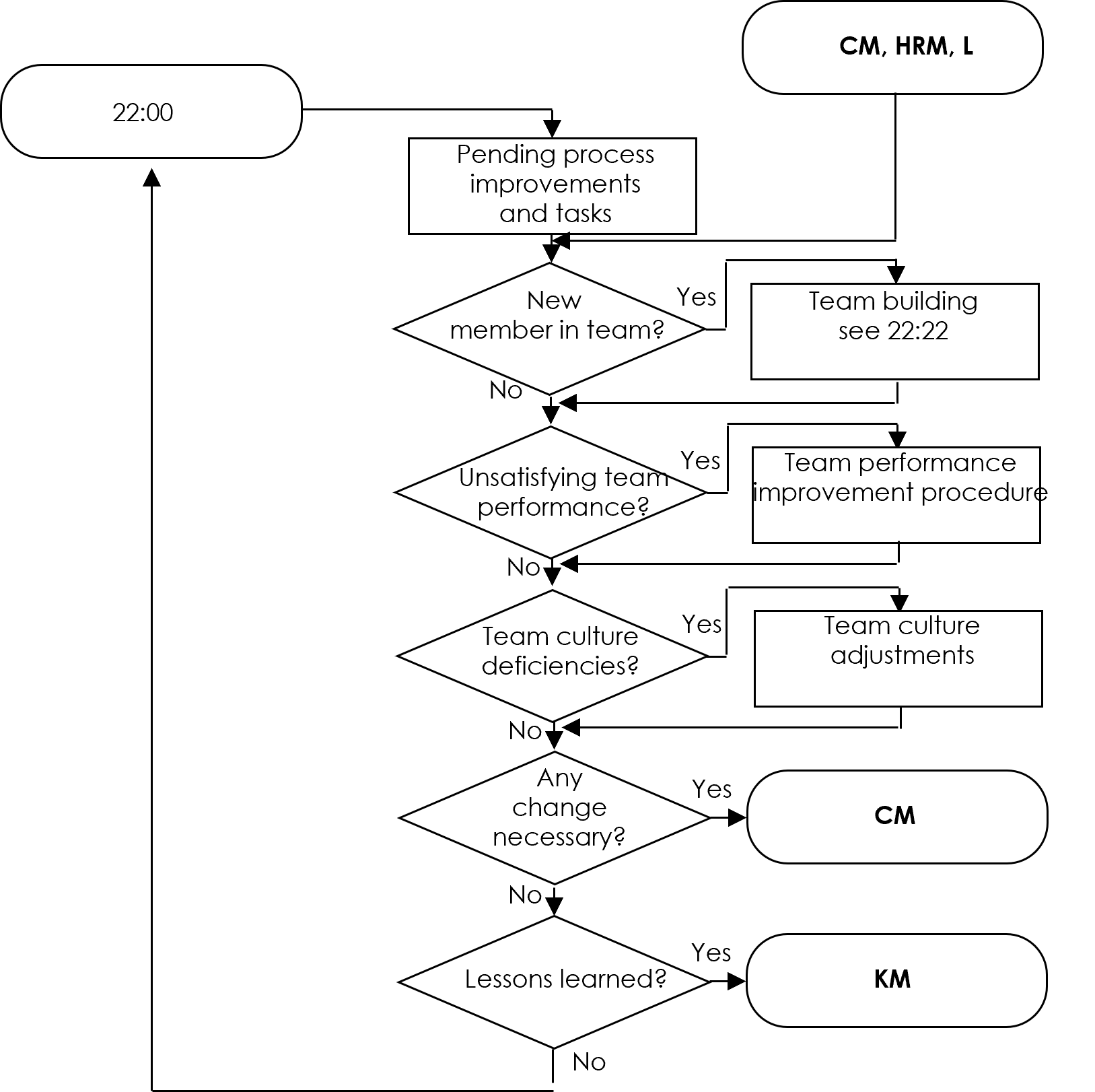
Verify and close pending process improvements and tasks. If there is a new team member initiating the process of his fastest integration in team. Watch if team performs – start appropriate procedure, in case any improvement potential emerges. Carefully observe the multicultural interrelations – do not hesitate to initiate clarification or adaptation of any rituals. After verifying all roles check if Change Request or Knowledge Management shall be addressed.

What Is the Work?

Team works efficiently if there are no major internal differences. Any new team member starts the team positioning from the scratch – so it takes time to settle. And this should be minimized. The higher is the team cohesion the better is its performance. Yet only project goal-oriented teams are efficient – any hidden agenda of highly coherent team is disastrous – definitely, must be avoided.

How Do I Ensure That I Have Done It Right?

Organize and lead fast team building activities, support multicultural knowledge and growth of mutual tolerance, take care about true focusing of the team on the project goals.
Goal

The goal of the process of Team Management TM is to maximize the effectiveness of a group measured according to the following criteria:

  • Team performance,
  • Satisfaction of team members,
  • Satisfaction of clients,
  • Improvement of a process,
  • Atmosphere of work in a group,
  • Team integration.

Clients’ satisfaction is measured in QM-Process, that of team members in HRM-Process. Evaluation of both is done in BSC-Process – all presented earlier in this book.

Process

Firstly, try to finalize all hanging issues, before you take on the new or changed role. Initiate the team building process each time someone new joins the team. Work hard on team performance and multicultural aspects next. Suggest changes, store knowledge and reenter the process periodically.

Team Management diagram

Further Readings

Cohn RC (1975/2009) Von der Psychoanalyse zur Themen zentrierten Interaktion: von der Behandlung einzelner zur einer Pa¨dagogik fu¨r alle, Klett-Cotta, Stuttgart

CU-Factor (2013) Toolbox, http://www.cu-factor.com/tool-box/doing-business-in-austria/over-view. Accessed 14 Feb 2011

Denisow K (1999) Soziale Strukturen, Gruppen und Team. In: Rationalisierungskuratorium der Deutschen Wirtschaft e.V. (Hrsg) Projektmanagement Fachmann, Band 1, 5. Auflage, Eschborn

Gellert M, Nowak C (2010) Teamarbeit-Teamentwicklung-Teamberatung. Ein Praxisbuch fu¨r die Arbeit in und mit Teams. Verlag Christa Limmer, Springer, Heilderberg

Hofstede G, Hofstede GJ (2005) Cultures and organisations, software of the mind. McGraw-Hill, New York

ISO 21500:2012 (2012) Guidance on project management, ICS 03.100.40, ISO Geneva

Janis IL (1982) Groupthink, Psychological Studies of policy decisions and fiascos. Houghton Mifflin Company, Boston

Lakhanpal B (1993) Understanding the factors influencing the performance of software develop-ment groups: an exploratory group-level analyse. Inf Softw Technol 35(8):168–173, USA

Luft J, Ingham H (1955) The Johari window, a graphic model of interpersonal awareness. In: Proceedings of the western training laboratory in group development, UCLA, Los Angeles

Morris MW, Peng K (1994) Culture and cause: American and Chinese attributions for social and physical events. J Personal Soc Psychol Vol. 67, No. 6, APA, New York

Tuckman BW (1965) Developmental sequence in small groups. Psychol Bull 63:384–399, APA, Washington

Tuckman BW, Jensen MAC (1977) Stages of small groups development revisited. Group Organ Studies 2, Newbury Park, USA

🎼

Practice questions coming soon.